

 Lionel
Between Èze and the Italian border, this stretch of coast is better explored by train and on foot than by car. The stations on the coastal line sit right at the start of the finest paths: the Chemin de Nietzsche, the Cap-Martin coastal walk, the Cap-d’Ail shore path. The secret is to string together a climb, a cove and a hilltop village in a single day, then ride the TER regional train home. Here is Menton, Monaco and the Riviera to the Italian border, the insider’s way.
Updated October 2026
At a glance
- Where: from Èze to Ventimiglia: Èze, Cap-d’Ail, Monaco, Roquebrune-Cap-Martin, Menton, and the hilltop villages of Sainte-Agnès, Gorbio and Castellar.
- When: all year round. Menton is famous for its mild winters; autumn and spring are perfect for the trails.
- Getting there: TER trains on the Nice–Ventimiglia line, with stations at Èze, Cap-d’Ail, Monaco, Carnolès, Roquebrune-Cap-Martin and Menton.
- Best for: walkers, lovers of gardens and architecture, and anyone curious about Italy next door.
- Good to know: several sites have seasonal closures or can only be visited by booking, such as Cap Moderne.
Why this stretch is like nowhere else
Here the Alps plunge straight into the sea. Between Monaco and Menton, the mountains block the north wind, and lemon trees are still grown in open ground. That terrain explains everything: hilltop villages a few minutes from the shore, balcony paths, and corniche roads stacked one above the other.
It is also border country. The sovereign Principality of Monaco sits in the middle. Menton and Roquebrune long belonged to the Grimaldis before becoming part of France in the 19th century. And Italy begins just beyond Menton: in Ventimiglia (Vintimille in French), the language, the coffee and the market all change.
Monaco: the must-sees, done differently
The Rock and the changing of the guard
Monaco-Ville, on the Rock, keeps its old lanes, its cathedral and the Prince’s Palace. Every day at 11.55am, the changing of the guard takes place on Place du Palais. The ceremony lasts about seven minutes. The Carabiniers wear black uniforms in winter and white in summer. The palace’s State Apartments (Grands Appartements) are open from April to October; the rest of the year they are closed to the public.
Insider tip: Place du Palais is packed at 11.55am. Instead, explore the lanes of the Rock early in the morning, then settle in at the edge of the square around 11.30am. Or skip the ceremony altogether and enjoy the viewpoint in the afternoon, once the crowds have gone.
The Oceanographic Museum
Founded by Prince Albert I and opened on 29 March 1910, this palace clinging to the cliff houses an aquarium of around a hundred tanks and more than 6,000 marine specimens. The Shark Lagoon is the star attraction. On the roof, the panoramic terrace has an area devoted to sea turtles, with a care centre.
- Opening hours: 10am to 6pm from October to March; 10am to 7pm from April to June and in September; 9.30am to 8pm in July and August.
- Closures: the Formula 1 Grand Prix weekend and 25 December.
- Access: the Parking des Pêcheurs car park, linked to the museum by lift, or about 15 minutes on foot from the station. Buses 1 and 2 go up to Monaco-Ville.
The Jardin Exotique, open at last
Closed in 2020 for lengthy works to stabilise the cliff, Monaco’s Jardin Exotique reopened on 30 March 2026, after six years of building work. It has gained new walkways and a new visitor reception. Clinging to the rock face above the city, it displays succulent plants with the sea as a backdrop. There is a car park about 200 metres away.
For more remarkable gardens along the coast, read our feature the Côte d’Azur’s gardens.
Èze, the village and the Chemin de Nietzsche
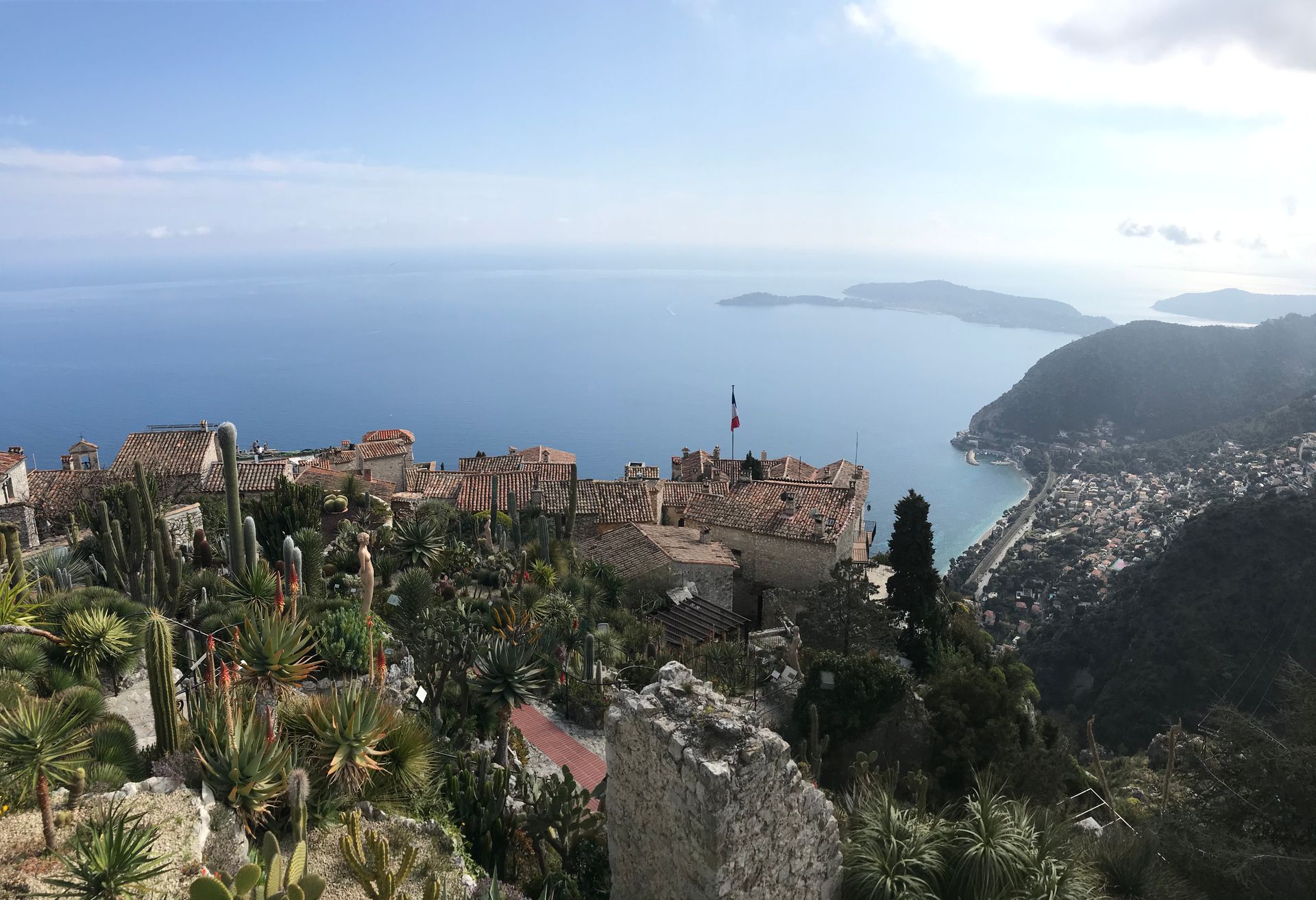
Èze rises to 429 metres on a rocky peak above the sea, about ten kilometres from Nice. At the top, the exotic garden fills the ruins of a medieval fortress. Cacti, aloes and agaves grow alongside sculptures by Jean-Philippe Richard. The panorama over the coast is one of the widest in the area. The garden is not wheelchair accessible; opening times vary with the season and should be confirmed with the garden.
The Chemin de Nietzsche
This path, named after the German philosopher, links the seafront with the village. According to the tourist office:
- Start: Èze-bord-de-Mer. From the station, walk east along the Basse Corniche (the lower coast road) for about 200 metres to the “Nietzsche” sign.
- Distance: 2.1 km.
- Time: about 1 hour going up.
- Ascent: about 400 metres.
- Terrain: a concrete section, then steps, then a paved stretch up to the village.
- Good to know: walking boots recommended; strongly discouraged with young children. Open access all year round.
Insider tip: take the TER to Èze, climb the Chemin de Nietzsche early in the morning while the hillside is still in shade, visit the village before the coaches arrive, then come back down the same path to catch the train. In summer, avoid the climb in the middle of the day at all costs.
Cap-d’Ail, the shoreline on the Monaco side
Cap-d’Ail is Monaco’s discreet gateway. Its coastal path links the Plage Mala, a small unspoilt beach in a calanque (a narrow rocky inlet) of white rock, with the Plage Marquet, near the Monaco border.
- Distance: about 3.5 km, an hour’s walk according to the tourist office.
- Difficulty: easy and family-friendly. The section between the Plage Marquet car park and the Pointe des Douaniers is wheelchair-accessible with assistance.
- Look out for: an old millstone quarry, the Belle Époque Villa Les Camélias, and Mediterranean plants explained on information panels.
- Access: Cap-d’Ail station or Lignes d’Azur bus no. 100. Paid car parks at the Plage Marquet and along the Route de la Mala.
- Note: the path is closed in bad weather.
Roquebrune-Cap-Martin, medieval village and modern cape
The village and its castle
Old Roquebrune clings to the hillside above the cape. Its castle was built in the 10th century as a defence against Saracen raids; it is billed as one of the oldest keeps in France. The Grimaldis restored it in 1528. You reach it only by steps from the centre of the village. From the top, the view stretches to Monaco on one side and to Menton and Italy on the other. For current opening times and prices, ask the Roquebrune-Cap-Martin tourist office.
The Cap-Martin coastal path
This is one of the most beautiful walks on the coast, and one of the easiest to organise by train.
- Start: Carnolès station, or the Menton seafront.
- Finish: Roquebrune-Cap-Martin station.
- Distance: 4.7 km one way.
- Ascent: modest, about 50 metres.
- Along the way: the bust of Le Corbusier, the Pointe du Cap-Martin with views from Menton as far as Bordighera, the pergola of the Villa Cypris, the Plage du Buse below, and the Cap Moderne site.
Cap Moderne, by booking only
Beside the path, Cap Moderne brings together Eileen Gray’s Villa E-1027 and Le Corbusier’s Cabanon. The site is fragile: it can only be seen on a guided tour, in small groups, and booking is compulsory on the official Cap Moderne website. The tour lasts about 2 hours and covers 1.5 km. The meeting point is near Roquebrune-Cap-Martin station, about 450 metres on foot along the Promenade Le Corbusier. It is not suitable for people with reduced mobility, young children or animals.
Insider tip: book Cap Moderne first, then build your day around it. Set off on foot from Carnolès along the Cap-Martin path, take the tour, and finish in the old village of Roquebrune. The TER brings you back from Roquebrune or Carnolès station.
Menton, the old town and the gardens
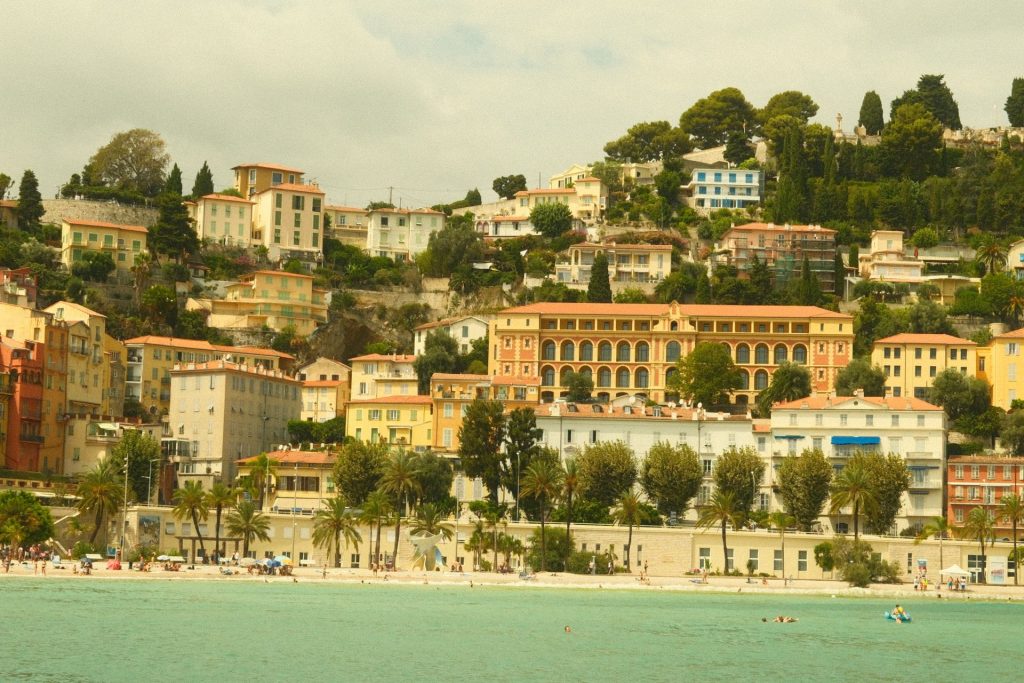
Menton is the town of lemons and gardens. Its old town cascades down to the sea in ochre façades, stepped lanes and terraced squares.
The old town
- The Basilique Saint-Michel-Archange: Baroque, with a colourful façade and a pebble-mosaic forecourt picturing the Grimaldi coat of arms. The Menton music festival is held here.
- The Bastion: a former harbour fort that in 1966 became the first museum devoted to Jean Cocteau.
- The wedding hall (Salle des Mariages): also decorated by Cocteau.
The gardens
Menton’s climate drew botanists and English gardeners. Four gardens to know:
- The Jardin Botanique du Val Rahmeh: run by the French National Museum of Natural History, 1.5 hectares and about 1,700 taxa, with a lotus and water-lily pond. Closed on Tuesdays; open 10am to 6pm from April to October, and 10am to 5pm the rest of the year.
- The Jardin Serre de la Madone: created from 1924 by Major Lawrence Johnston. Open Tuesday to Sunday, closed on Mondays and in November and December.
- The garden of the Palais Carnolès: nearly 137 varieties of citrus, awarded “Jardin Remarquable” (outstanding garden) status in 2005.
- Fontana Rosa and Maria Serena: two more of the town’s gardens; ask the tourist office about visiting arrangements.
The Fête du Citron, Menton’s lemon festival in February, deserves an article of its own: see our tips for the Menton Lemon Festival without the crowds.
Beaches and coves
The area alternates between town pebble beaches and small rocky inlets. The loveliest are reached on foot.
- Plage Mala, Cap-d’Ail: a calanque of white rock, at the end of the coastal path.
- Plage Marquet, Cap-d’Ail: at the foot of Monaco, easier to reach, with a paid car park.
- Plage du Buse, Roquebrune-Cap-Martin: below the Cap-Martin path.
- Menton’s beaches: one after another along the seafront, on either side of the old town.
More hidden coves in our guide to the secret beaches of the Côte d’Azur.
The hilltop villages around Menton
Sainte-Agnès
The tourist office bills it as the highest coastal village in Europe. One of the Plus Beaux Villages de France, the official list of France’s most beautiful villages, it has kept its cobbled lanes and medieval character. The Maginot Line fort, about 4 km from the border, was used to repel Italian troops in June 1940; it can be seen on a guided tour, tunnels included. Also worth seeing: the 16th-century Église Notre-Dame-des-Neiges, and the medieval garden on the site of the old castle.
Gorbio
Between Roquebrune and Menton, Gorbio lines up arcaded houses, vaulted passages and a pointed-arch gateway. On the square, an elm planted in 1713 is one of France’s 200 “remarkable trees”. The 17th-century château of the Counts Alziari de Malaussène still belongs to the same family; the tower of the former Lascaris castle hosts an exhibition in summer.
Castellar and Castillon
Castellar is the last hilltop village before Italy, with parallel streets linked by traverses (connecting passages) and a working olive mill. Castillon, about 7 km from Menton, was rebuilt lower down after the 1887 earthquake. It is a good starting point for walks to the Col de Castillon and the Caramel viaduct, on a former tramway line.
For more outstanding villages, see our selection of the most beautiful villages of the Côte d’Azur.
The Italian escape: Ventimiglia
A few minutes by train beyond Menton, Ventimiglia marks the start of the Italian Riviera. Its weekly market is held on Friday mornings, all year round, from 8am to 1pm: food, fruit and vegetables, local produce and clothes. It draws big crowds from both sides of the border.
- Getting there: by TER; Ventimiglia station is the end of the coastal line from Nice.
- Best time: early in the morning. Trains and roads are busy on Fridays.
- Bring: an identity document, since you are crossing the border.
Insider tip: on Fridays, leave the car behind. Take one of the first TER trains from Menton, do the market before 10am, then climb up to Ventimiglia’s old town on the hill, which is much quieter. You will be back before the midday rush.
Food and markets
According to the tourist office listings. Times can change, so check before you travel.
- Menton, Marché des Halles: daily from 8am to 1pm, on Quai de Monléon, between the port and the old town. Around thirty traders sell fresh, local produce; on Mondays few stalls are open. The market hall dates from 1898, and its façade bears ceramics from Menton’s Saïssi workshop.
- Menton on Saturdays: clothing stalls set up on Place Fornari and on the Mail du Bastion.
- Ventimiglia: big market on Friday mornings.
- Monaco: ask the Principality’s tourist office about the Condamine market.
To try: Menton lemons in every form, olive oil from the villages and, across the border, Ligurian focaccia.
For the area’s traditions, read our feature on culture and traditions of the Côte d’Azur.
When to go (and why the off season is ideal)
- October–November: the sea is still mild in early October and the trails are pleasant. The Serre de la Madone closes in November and December.
- December–January: a mild, bright winter. Ideal for the hilltop villages and the Chemin de Nietzsche. The State Apartments of the Prince’s Palace are closed.
- February: the Fête du Citron, from 13 to 28 February 2027; Menton is very busy then.
- March–June: gardens in bloom, the State Apartments open from April, swimming possible from June.
- July–August: crowds and heat. Walk early, book Cap Moderne in advance, and avoid the Grand Prix weekend in Monaco.
More ideas for the low season in our article on the Riviera in winter.
Getting around and parking
- By TER: the best option. The Nice–Ventimiglia line serves Èze, Cap-d’Ail, Monaco-Monte-Carlo, Carnolès, Roquebrune-Cap-Martin and Menton, so you can walk each path one way. Check timetables on the Région Sud TER website.
- By bus: Lignes d’Azur line 100 runs along the Basse Corniche, handy for Cap-d’Ail. In Monaco, the Compagnie des Autobus de Monaco buses and an electric boat-bus cross Port Hercule.
- Monaco on foot: the Principality has many public lifts and escalators linking its hillside districts.
- By car: three stacked corniche roads link Nice and Menton, and they are often busy. Monaco has some forty public car parks, mostly underground. Driving into Monaco-Ville is restricted to vehicles registered in Monaco or in the Alpes-Maritimes, with proof of address: park at the Parking des Pêcheurs.
- Hilltop villages: narrow, winding roads, with parking at the village entrance; the villages themselves are explored on foot.
Where to stay
To explore by train, stay in Menton, which is well served by rail, or in Roquebrune-Cap-Martin, near Carnolès and Roquebrune stations; for peace and panoramas, the guesthouses and gîtes (self-catering cottages) of Sainte-Agnès, Gorbio or Èze show a very different side of the coast.
No hand-picked campsite in Menton itself yet. The nearest on Yes I Camp: La Vieille Ferme (Villeneuve-Loubet) and Le Parc des Maurettes (Villeneuve-Loubet).
See also all our campsites in Provence-Alpes-Côte d’Azur on Yes I Camp.
FAQ
Is Monaco’s Jardin Exotique open?
Yes. Closed in 2020 for works to stabilise the cliff, it reopened to the public on 30 March 2026. Check the day’s opening times with the Mairie de Monaco (town hall) before you go.
How long does the Chemin de Nietzsche take?
About an hour going up, for 2.1 km and nearly 400 metres of ascent, from Èze-bord-de-Mer to the village. The path is steep, with steps: walking boots are recommended, and set off early in summer.
Can you visit Cap Moderne without booking?
No. Villa E-1027 and Le Corbusier’s Cabanon can only be seen on a guided tour, in small groups, by reservation. The meeting point is near Roquebrune-Cap-Martin station.
Which day is the Ventimiglia market?
Friday morning, all year round, from roughly 8am to 1pm. Come by TER and come early: it is the busiest day on the roads and on the trains around the border.
When is the Marché des Halles in Menton open?
Daily from 8am to 1pm, on Quai de Monléon. On Mondays few traders are there, so choose another day to see the full range of stalls.
Further reading
- Nice and its hill villages: an insider’s guide
- Cannes, the Lérins Islands and Grasse beyond the glitz
- The secret Estérel: red-rock coves, trails and villages
- The secret Gulf of Saint-Tropez: an insider’s guide
- Menton Lemon Festival: how to enjoy it without the crowds
- The French Riviera’s gardens: 12 to visit
- The French Riviera in winter: 15 off-season ideas