
 Lionel

On the Riviera, traditions are not re-enactments staged for tourists. The bravadeurs of Saint-Tropez have paraded for their saint since 1558, and the firefighters of Grasse still spray the crowd with jasmine water. The secret: every big festival has a more intimate version, a few weeks or a few kilometres away.
Updated October 2026
At a glance
- Where: from Saint-Tropez to Menton, with Grasse, Vallauris, Biot and Nice as key stops.
- When: Provençal Christmas from December to early February, carnivals and parades in February, bravades in May and June, jasmine in early August.
- Getting in: most festivals are free; the Nice Carnival and the Lemon Festival are ticketed.
- Who it’s for: families, anyone curious about Provençal culture, craft lovers.
The Bravades of Saint-Tropez, every year from 16 to 18 May
This is no folk festival. It is a genuine military parade, held since 1558 in honour of Saint Torpes, the town’s patron saint, who is said to have come ashore in the Pilon district in the year 68.
For three days, the people of Saint-Tropez march under arms in period uniform: musketeers, sailors, Pisan gentlemen. The capitaine de ville, who leads that year’s bravades, is elected on Easter Monday by the town council, on the recommendation of the Cepoun, the keeper of the traditions.
History explains the fervour. In 1470, Saint-Tropez became a “land of privileges”, exempt from taxes and entitled to raise its own militia. Louis XIV abolished these privileges in 1672. The bravade keeps their memory alive.
- Dates: 16, 17 and 18 May, every year.
- Plan ahead: the village is very busy, so come early and on foot if you can.
Insider tip: if the May crowds put you off, come back on 15 June for the Bravade des Espagnols. It commemorates the victory of 15 June 1637, when 21 Spanish galleys that had entered the gulf failed to sink four of the king’s ships under repair in the port. It is free and the atmosphere is more intimate.
The Calendale festivities: two months of Provençal Christmas
In Provence, Christmas is not over in a single evening. The Calendale season runs from Saint Barbara’s Day, 4 December, to Candlemas, 2 February.
Saint Barbara’s wheat
On 4 December, wheat is sown in saucers lined with damp cotton wool. If it grows green and straight, the year will be a good one. The saucers then join the nativity scene.
The crèche and its santons
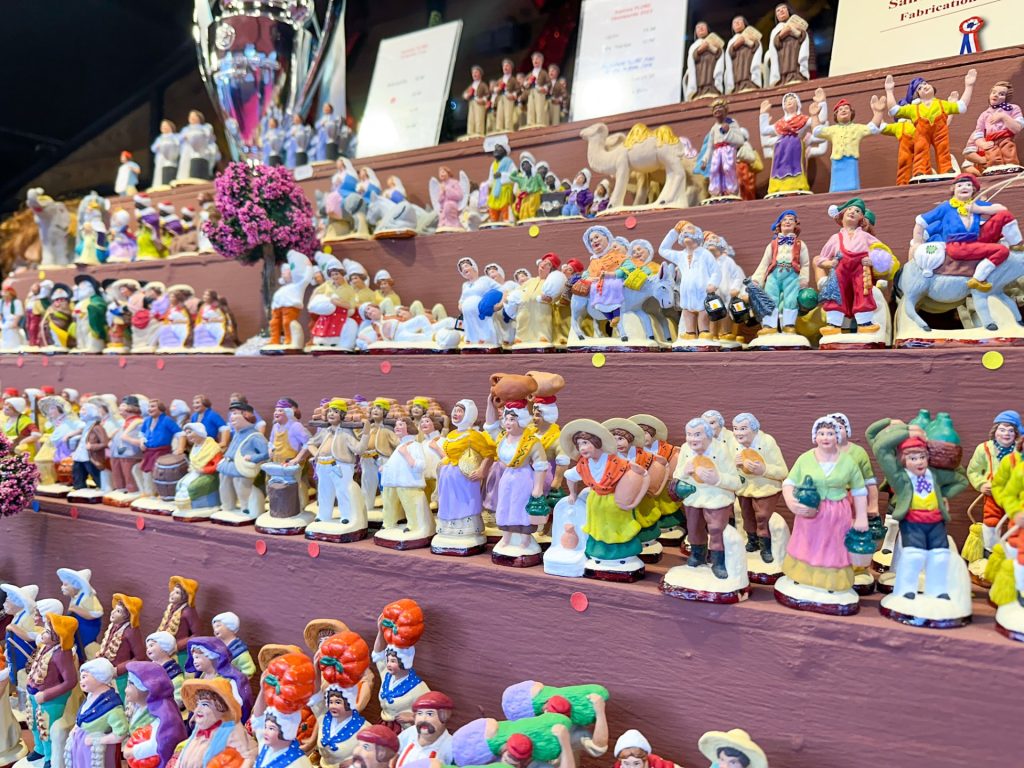
The Provençal crèche, or nativity scene, is peopled with santons, small clay figures representing the trades of the village gathered around the Nativity. Provençal Christmas markets sell them, alongside crafts and local produce.
The gros souper and the 13 desserts
On the evening of 24 December, the table is laid with three white tablecloths, three candles and the sprouted wheat. Seven meatless dishes are served for the gros souper (the “big supper”), in memory of the seven sorrows of Mary. Then come the 13 desserts: dried fruit, dates, nougat, candied fruit, fresh fruit… The selection varies from family to family and village to village.
Midnight Mass and the pastorale
Some midnight Masses are accompanied by fifes and tambourins (Provençal drums), with carols sung in Provençal. The pastorale, a spoken and sung play about the Nativity, carries the tradition on. The best known is the Pastorale Maurel. To find a performance near you, ask the tourist office or the parish.
February, the month of parades: Nice, Menton, Mandelieu
Winter on the Côte d’Azur is celebrated outdoors. Three events follow one another in February, just a few kilometres apart.
The Nice Carnival
Billed as France’s leading carnival with an international reach, it takes over the Place Masséna. The 2027 edition, on the theme “Vive l’Amour”, is scheduled for 9 to 28 February 2027. The parades are ticketed.
The Lemon Festival in Menton
The 93rd Fête du Citron, “Douce France”, is scheduled for 13 to 28 February 2027. It draws more than 200,000 visitors a year and has been on France’s inventory of intangible cultural heritage since 2019.
- Programme: daytime Golden Fruit Parades and night-time parades along the seafront, around the casino; giant citrus sculptures in the Jardins Biovès; a craft market and an orchid show.
- Tickets: online on the official website; everyone needs a ticket, children under 6 included.
- Good to know: dogs are not allowed at the parade; the organisers recommend coming by train or bus.
The Mimosa Festival in Mandelieu-la-Napoule
Held for more than 95 years, it is scheduled for 10 to 14 February 2027, on the theme “Le mimosa entre en jeu” (Mimosa joins the game). The flower parade (corso fleuri) makes its way along the seafront on Sunday afternoon, opposite the Château de La Napoule.
Insider tip: in 2027 the three festivals overlap in mid-February. Take the train: Nice, Menton and Mandelieu are on the same coastal line. You’ll avoid the traffic jams and the packed car parks on parade days.
The Fête des Mai in Nice, all through May
Less well known than the carnival, the Fête des Mai celebrates spring and the traditions of Nice. It takes place in the gardens of the Cimiez arena, in the shade of the olive trees: folk dancing, concerts, balètis (traditional dances), local specialities and children’s activities.
- When: all through May (1 to 30 May 2027, according to the tourist office’s events calendar).
- Where: the gardens of the Cimiez arena, near the Musée Matisse.
Grasse: perfume, a heritage of humanity
On 28 November 2018, UNESCO added the “skills related to perfume in the Pays de Grasse” to the Representative List of the Intangible Cultural Heritage of Humanity. The listing covers three strands: growing perfume plants, knowledge of natural raw materials and how to process them, and the art of composing perfume.
The gardens of the International Perfume Museum
At Mouans-Sartoux, near Grasse, these gardens occupy an old country house (bastide) where jasmine and roses were still grown in the 1950s. You can see centifolia rose, jasmine, tuberose, iris and rose geranium growing there.
- Opening: daily from late March to mid-November; closed on 1 May.
The Jasmine Festival, on the first weekend of August
It has been held since 1946. On Friday there is a dance and fireworks; on Saturday, a flower market followed by an evening flower parade; on Sunday, a Provençal Mass, a grand aïoli (the garlic-mayonnaise feast) and a “Mondial parfumé de boules carrées”, a perfumed world championship of square-ball pétanque. The first flower-decked floats appeared in 1948; today they carry tens of thousands of flowers. During the parade, firefighters spray the crowd with jasmine-scented water. The 2026 edition was held from 31 July to 2 August; the 2027 dates will be announced by the town.
Earth and fire: Vallauris pottery, Salernes tiles, Biot glass
Vallauris, the potters’ town
Ceramics are the soul of Vallauris. They enjoyed a great revival in the 1950s, when Picasso was working clay at the Madoura workshop. The Musée Magnelli, the ceramics museum, occupies the castle. The Musée de la Poterie, opened in 1989 in an 1868 pottery works, shows every stage of production. The Biennale des céramistes d’art showcases today’s makers.
- In summer: the “Un été céramique” (A ceramic summer) programme, which ran from 4 July to 30 September in 2026, opens up a number of workshops and galleries.
Salernes, the red clay of the Var
Salernes has been working clay for more than 7,000 years. In the early 19th century, its red clay gave rise to the hexagonal tomettes (terracotta floor tiles) that soon covered floors from Nice to Marseille. The Musée Terra Rossa tells this story and exhibits contemporary ceramicists. The village workshops still produce for architects and interior designers.
Biot, bubble glass
The Verrerie de Biot, founded in 1956 by Eloi Monod, invented bubble glass. It holds the Entreprise du Patrimoine Vivant (Living Heritage Company) label. On site, the Galerie Internationale du Verre shows the work of glass artists from around the world.
- Entry: free.
- Annual closure: 15 to 27 January.
- Things to do: a glass-blowing taster session with a master glassblower, by reservation.
Insider tip: in Vallauris, the combined ticket for the Musée Magnelli and the Musée National Picasso lets you see ceramics and painting in the same castle. In Biot, call the glassworks before you come to find out the glass-blowing session times: they are by reservation only.
Where to stay
For the February festivals, a base in Nice or Menton, close to a railway station, makes everything easier. For Grasse and the perfume route, opt for a guesthouse in the Pays de Grasse. For the bravades, book very early in the Gulf of Saint-Tropez, or stay in a neighbouring village such as Gassin or Ramatuelle.
See also all our campsites in Provence-Alpes-Côte d’Azur and our off-season camping guide on Yes I Camp.
Further reading
- Christmas markets and Provençal nativity scenes on the Riviera
- Menton Lemon Festival: how to enjoy it without the crowds
- The Mimosa Route from Bormes to Grasse in 3 days
- The most beautiful hill villages of the French Riviera
- In the footsteps of the Riviera’s painters
FAQ
When are the Saint-Tropez bravades held?
Every year on 16, 17 and 18 May, in honour of Saint Torpes. A second bravade, known as the Spanish bravade, takes place on 15 June, in a more intimate atmosphere.
What are the dates of the February 2027 festivals?
The Nice Carnival is scheduled for 9 to 28 February 2027, the Menton Lemon Festival for 13 to 28 February and the Mandelieu-la-Napoule Mimosa Festival for 10 to 14 February.
What are the 13 Christmas desserts?
Served on the evening of 24 December after the ‘gros souper’, they include dried fruit, dates, nougat, candied fruit and fresh fruit. The exact selection varies from family to family and village to village.
When is the Jasmine Festival in Grasse?
On the first weekend of August. During the flower parade on the Saturday evening, firefighters spray the crowd with jasmine-scented water.